Updated on July 28, 2026
If you're planning to take a drive for hire - whether driving limousines, executive vehicle or shuttle van or even a fleet vehicle for corporate use There's a good chance you've encountered the term "chauffeur's permit" and wondered how it differs from the driver's license you already have within your purse. This guide explains exactly what a driver's permit is, and how it compares to the Commercial Driver's License (CDL) and what it is to obtain one.
What Is a Chauffeur's Permit?
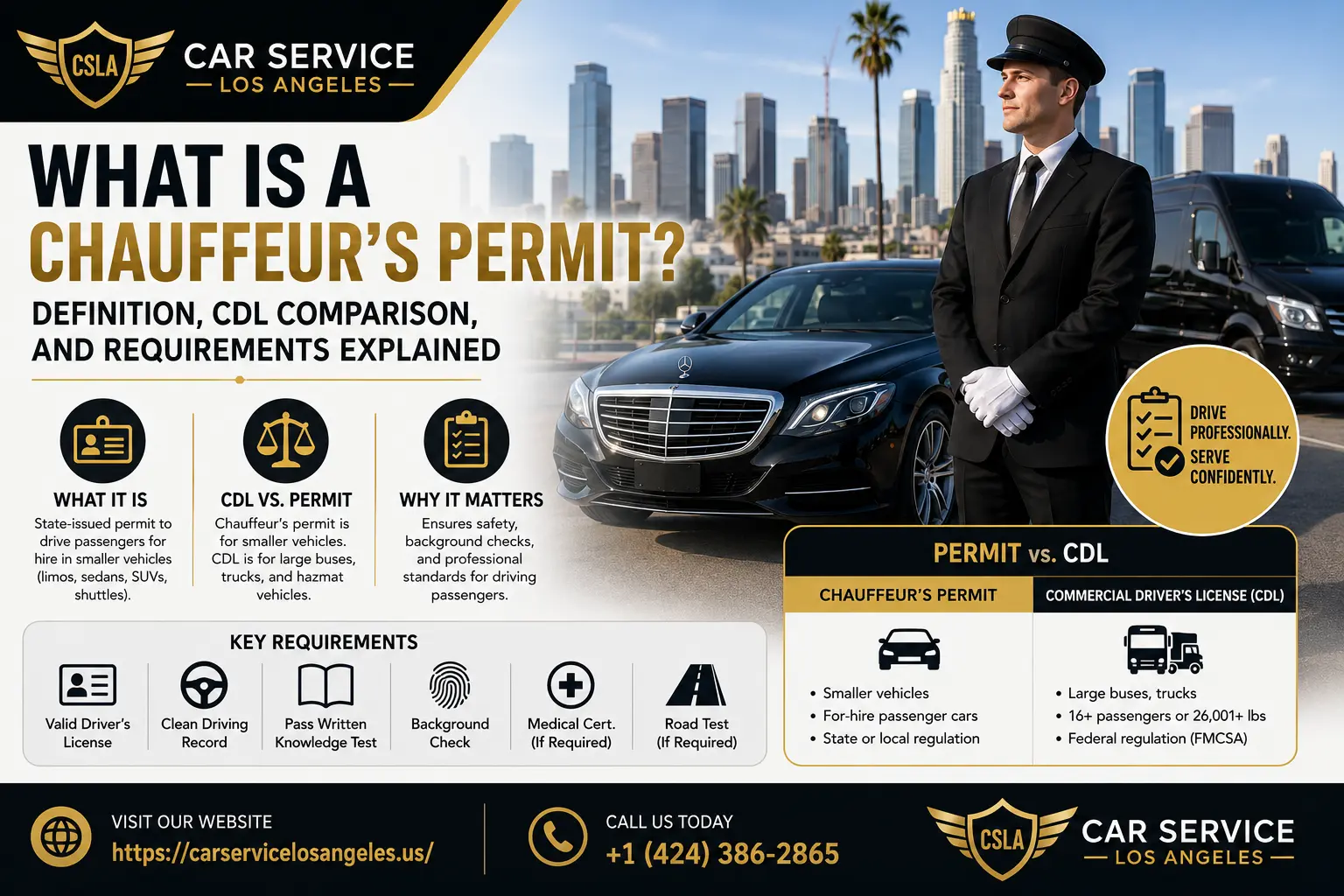
A chauffeur's permit is a government-issued authorization that permits drivers to legally transport guests on hire in a vehicle that doesn't require a Commercial Driver's License. It's a middle-of-the-road between a regular driver's license and the CDL. It's there specifically to prove that a driver meets additional safety, background, and competency requirements before they can be allowed to be trusted with paying passengers.
In simple terms, a standard license permits you to drive your family and yourself around. A chauffeur's permit allows you to earn money to chauffeur others around. Think limousines, black-cars, Executive SUVs, shuttle buses and other similar passenger vehicles for hire with affordable car service Los Angeles.
Why Does the Chauffeur's Permit Exist?
Drivers hired for hire have a greater obligation of care than normal driving. States established the chauffeur's permit category to ensure that professionals are driving.
- Maintain a clear or minimally restricted driving record
- Have passed additional information and/or road tests
- Have passed any background checks that are necessary
- Know the importance of punctuality, safety for passengers guidelines, and the professional behavior expectations
This is the reason the rules for chauffeur permits are formulated by the local (and often city) level, not federally and the rules can vary in significant ways depending on the place you live and where you work.
Is a Chauffeur License a Commercial Driver License (CDL)?
It's not true that a chauffeur's license and CDL are not the same thing. CDL aren't the exact same thing, but they're both closely linked and can overlap. CDL is a federally-regulated license that allows the operation of big or bulky commercial vehicles. Think of buses, tractor-trailers, as well as vehicles that haul dangerous substances. A driver's license, by contrast, is usually an endorsement issued by the state for drivers of passenger vehicles that are smaller that are used for commercial purposes.
Here's a distinction that most drivers encounter:
|
Chauffeur's Permit |
Commercial Driver's License (CDL) |
|
|
Governs |
Smaller for-hire passenger cars (sedans and limos mini shuttles) |
Large buses, heavy trucks and hazmat carriers |
|
Typical trigger |
Driving passengers for pay |
Vehicles with GVWRs over 26,001 pounds or seating more than 16 people or hazardous |
|
Regulation level |
Municipal or state-owned |
Federal (FMCSA) which is managed by states |
|
Testing |
Written knowledge test; occasionally an on-road test |
Written and skills tests usually with specific endorsements for vehicles |
When You Might Need Both
When you're operating a big party bus, passenger van or other vehicle built to hold more than 16 people (including yourself) Many states require a CDL in addition to or, sometimes, in lieu of the endorsement of a chauffeur. A driver who is moving between smaller cars and larger shuttles should be aware of the license category that applies to each class of vehicle prior to driving.
The bottom line is that if you're just driving an automobile or SUV, or a limousine to hire, a chauffeur's license is generally enough. If your fleet comprises more heavy or larger vehicles, you'll require an CDL also.
Chauffeur License Requirements
Because the licensing of chauffeurs is done on a state (and sometimes at the city) level, the exact regulations vary, but the majority of jurisdictions base their requirements on the same structure.
1. Hold a Valid Standard Driver's License
The applicant must hold an unrestricted or minimally restricted driver's license in their state. This is the basis that proves the general competence of a driver prior to any further professional testing begins.
2. Meet Minimum Age and Driving History Standards
The majority of states have an age limit (commonly the age range is 18-21) and demand an unclean or nearly clean driving record from the last look-back period, usually the last two to five years. Infractions that are serious (such as DUIs or reckless driving, excessive points could delay or even disqualify the application until a waiting time has passed or a remedial program is completed.
3. Pass a Written Knowledge Exam
The majority of applicants take a written exam covering the traffic law, passenger safety and professional conduct requirements. Certain states will waive this requirement in the event that the applicant already has a valid CDL or commercial learners license, as that test covers the same ground.
4. Complete a Background Check
Since chauffeurs interact directly in direct contact with people, several cities and states need fingerprinting, as well as criminal background examination prior to the issuance of the license.
5. Provide Medical Certification (Where Required)
Drivers of certain types of vehicles may require a medical certificate that proves they're physically fit to operate professionally.
6. Submit Documentation and Pay Applicable Fees
A typical application will include evidence of identity as well as proof of residency Social Security verification, driving history, and in certain roles the employer's letter. The fees differ by state and type of permit.
7. Pass a Road Test (If Required)
Candidates who are first-time without professional credentials for driving are often required to show their driving abilities in person as well as pass a written test.
Quick-Answer Summary
What is a chauffeur's license?
A state-issued permit that authorizes the transportation of passengers for a fee within smaller vehicles for hire.
Is it a CDL?
Not really. A CDL is for heavier vehicles and more passengers A chauffeur's permit is for regular-sized for-hire vehicles.
What do you require to obtain one?
A valid driver's license, clear driving record, a passing knowledge test background check clearance and, depending on the state, an examination on the road and medical certificate.
Always Confirm With Your State DMV
Since the rules for chauffeur permits differ in each state, and even per city, the above details provide a general guideline and not any guarantee for your particular place of residence. Before submitting an application, consult directly with the State's Department of Motor Vehicles or transportation authority to verify the current age limit, test requirements, and the fees applicable to the area you live in.fhire
Recent Posts

Book SUV Car Service for Sip and Stroll at SoFi Stadium
Posted on September 10, 2026

Limo Service to 78th Primetime Emmy Awards at Peacock Theater
Posted on September 10, 2026

Book Limo Service for Usher & Chris Brown's "The R&B Tour" at SoFi Stadium
Posted on September 05, 2026
Executive Car Service Warner Village | Premium Transfers
Posted on September 02, 2026
Share


